
Short version: gelato has less air, less fat, and is served warmer than American ice cream. Those three things are the whole argument. Less air means more actual dessert per spoon. Less fat means the flavoring is not coated over by butterfat. A warmer serving temperature means your tongue is not numb when the flavor arrives. Everything else in this article is detail on top of that.
Key Takeaways
- Gelato is Italian for "frozen." In Italy the word covers everything frozen and sweet. In America it has come to mean a specific style: milk-forward, low overrun, served warmer.
- Ice cream is a legal term in the United States. Gelato is not. The FDA sets a standard of identity for ice cream requiring at least 10 percent milkfat. There is no equivalent federal standard for gelato.
- Fat content: gelato usually lands around 4 to 9 percent milkfat. American ice cream starts at 10 percent by law and premium versions run much higher.
- Overrun (air): gelato is typically churned more slowly to roughly 20 to 35 percent overrun. Ice cream is churned quickly and can approach 50 percent or more.
- Serving temperature: gelato is served roughly 10 to 15°F warmer than ice cream, which is why it stays soft and why the flavor reads louder.
- Sorbet and sorbetto are the same thing. One word is English, one is Italian. There is no technical difference.
First, the annoying truth: "gelato" just means "frozen"
Let us get this out of the way, because half the internet gets it wrong.
Gelato is the Italian word for frozen. Walk into a shop in Rome and ask for gelato and you are asking for ice cream, in the plain sense. Italians do not think of gelato and ice cream as rivals. They think of gelato as what frozen dessert is.
What happened is that American ice cream went one direction and Italian gelato went another. American manufacturers leaned into cream, egg yolks, air, and hard freezing. Italian makers stayed with milk, slower churning, and a warmer case. Same family. Very different results.
So when this article says gelato is better than ice cream, it means the Italian production method beats the American industrial one on flavor. That is a defensible claim, and the rest of this piece defends it.
One more piece of vocabulary. Sorbet and sorbetto are the same product. Sorbetto is simply the Italian spelling. Both are fruit and sugar and water, no dairy, and both are naturally dairy free. Sherbet is a separate animal: under FDA rules, sherbet sits between the two with 1 to 2 percent milkfat.
A short history of gelato, minus the myths
You will read a lot of confident claims about who invented gelato. Most of them are folklore that hardened into fact through repetition. Here is the version worth trusting, with the hedging left in.
Florence, 1500s
The story that keeps surfacing puts a Florentine named Bernardo Buontalenti at the center. He was an architect, engineer, and stage designer for the Medici court, and he is traditionally credited with serving a frozen milk-and-egg dessert at a banquet in the late 1500s, sometimes said to honor a visiting Spanish delegation.
Was he the first? Almost certainly not. Frozen sweets built on snow, ice, honey, and fruit go back much further and show up in several cultures independently. But the Buontalenti account is the moment the recipe picks up milk, cream, sugar, and egg yolks, which is the point where it starts to resemble gelato as we mean it now. Treat it as tradition rather than documented fact.
Paris, 1686
The better documented turning point is a Sicilian named Francesco Procopio dei Coltelli, also recorded as Procopio Cutò. In 1686 he opened Café Procope in Paris and sold frozen desserts across a counter to anyone who could pay.
That is the real shift. Before Procope, this was banquet theater for nobility. After, it was a product with customers. The café became a hangout for the literary crowd and still operates today. Once the thing could be sold, it could be refined, priced, and taught. That is when gelato became a trade instead of a party trick.
Hoboken, 1903
Here is the part most gelato articles skip, and it happened about eight miles from where Baci makes gelato today.
Italo Marchiony arrived from Italy in 1895 and sold lemon ice and frozen desserts from a pushcart on Wall Street. He served them in little glass dishes that customers kept walking off with or breaking. His fix was to bake an edible cup out of waffle batter.
He filed a patent in 1902 and was granted U.S. Patent 746,971 in December 1903 for a molding apparatus that could bake ten cups at a time. By 1904 he was running a wholesale operation out of Hoboken, New Jersey, with a fleet of horse-drawn wagons supplying retailers across the metropolitan area. At his peak he had dozens of vendors working Manhattan.
Marchiony's story usually gets told as an ice cream cone origin story, and there is a whole feud with rival claimants at the 1904 St. Louis World's Fair. What interests us more is the business model. An Italian immigrant in northern New Jersey, making frozen dessert and cones and cups, and delivering them wholesale into New York every day. That is a template that never really stopped working here.
When did gelato actually become a trend in America?
Later than you think. And the first attempt failed.
1998: Häagen-Dazs launched a gelato line in the United States. It did not take. Shoppers could not articulate what made it different from the ice cream sitting next to it, so they defaulted to what they knew.
2003: Talenti opened as a single storefront gelateria in Dallas. Its founder had apprenticed at a family gelateria in Buenos Aires. According to Boston University's account of the company, it took pitching 108 investors to get the thing funded. The brand is named after Buontalenti, which is a nice loop back to Florence.
Mid-2000s: independent gelaterias started opening in American cities in real numbers, and chefs began putting gelato and sorbet on dessert menus as a plated component rather than a scoop in a dish. Baci Gelato opened in Norwood, New Jersey in 2005, right in the middle of that wave. Twenty years on, that timing looks less like luck and more like reading the room.
2014: Unilever bought Talenti. By the mid-2010s gelato was one of the fastest growing corners of the American frozen dessert category, and by 2016 it accounted for roughly 5 percent of the U.S. ice cream market by value.
The pattern is worth noticing. Gelato did not win in America by being exotic. It won once enough people had tasted the difference to know what they were choosing.
Six fun facts before we get to the list
- Gelato melts faster than ice cream. Warmer serving temperature, less fat, less air. If it is holding its shape under a hot lamp for twenty minutes, something is off.
- The Marchiony family sued each other over cones. Italo's cousin Frank, a Brooklyn ice cream maker, held a competing patent on an edible cup. A federal court eventually decided everyone could make them.
- "Hokey-pokey men" was what Americans called Italian frozen dessert vendors in the early 1900s, a mangling of ecco un poco, "here's a little."
- Fior di latte means "flower of the milk." It is gelato with no flavoring at all beyond milk, cream, and sugar. It is the hardest flavor to make well because there is nothing to hide behind. Its close cousin fior di panna leans on cream instead.
- Stracciatella is a technique, not an ingredient. Warm liquid chocolate gets drizzled into churning gelato and shatters into irregular shards on contact. It is not chocolate chips. It cannot be made by stirring chips in.
- Gelato has no legal definition in the United States. Ice cream does. More on why that cuts both ways below.
The 10 reasons gelato beats ice cream
1. Less air means you are actually buying dessert
Overrun is the industry term for air whipped into the mix during freezing. It is measured as a percentage of volume increase.
Gelato is typically churned slowly to roughly 20 to 35 percent overrun. Fast-churned American ice cream can hit 50 percent or higher, and at the economy end of the shelf, a container can be close to half air.
This is not a small detail. It is the single biggest reason a cup of gelato feels heavier than the same cup of ice cream. You are getting more mix and less nothing.
The FDA quietly enforces a floor on this. Under 21 CFR 135.110, ice cream must weigh at least 4.5 pounds per gallon. That weight minimum exists specifically to stop manufacturers from inflating a half gallon with air until there is barely any product left. The fact that the rule had to be written tells you what was happening.
2. Lower fat content lets the flavor through
American ice cream must contain at least 10 percent milkfat to be legally called ice cream, per the International Dairy Foods Association's summary of federal labeling rules. Premium and super-premium versions push well past that.
Gelato generally sits around 4 to 9 percent milkfat.
Here is why that matters, and it is not a health argument. Butterfat coats your tongue. It delivers a rich, rounded mouthfeel, and it also physically buffers your palate from the flavoring compounds sitting in the mix. Pistachio in a 16 percent butterfat base tastes like a very good creamy dessert with a pistachio suggestion. The same pistachio in a 6 percent base tastes like pistachio.
Less fat is not a compromise here. It is the entire point.
3. It is served warmer, so your mouth still works
This one gets overlooked and it might be the most important.
Ice cream is stored and served hard, around 0°F. Gelato is served roughly 10 to 15°F warmer.
Cold numbs your taste receptors. That is basic physiology. Serve something at 0°F and the first few seconds in your mouth are spent thawing before you register anything but sweetness and cold. A warmer serving temperature skips that lag. The flavor lands immediately and it lands at full volume.
This is also why gelato has that soft, spreadable, almost elastic texture instead of a hard scoop. It is not a different recipe trick. It is temperature.
4. Milk-forward, not cream-forward
Ice cream is built on cream. Gelato is built on milk, with cream in a supporting role and often fewer egg yolks or none at all.
Counterintuitively, this makes gelato denser, not lighter. Cream traps air more readily than milk when churned. Less cream means less air holding capacity, which loops right back to reason one.
The food writer Max Falkowitz, who spent years covering frozen desserts for Serious Eats and Saveur, has written about this at length: the neutral, milk-based background is what lets an added flavor read clearly instead of getting absorbed into richness.
5. Slower churning produces a better texture
Ice cream is churned quickly. Gelato is churned more slowly.
Speed determines ice crystal size and air cell structure. Fast, aggressive churning produces a fluffy, aerated consistency. A slower churn produces smaller, tighter crystals and a silkier texture that reads on the tongue as dense and smooth rather than airy.
Stabilizers and emulsifiers can approximate some of this in a fast process. They cannot fully replicate it. There is a reason the industrial shortcut has not put artisan production out of business.
6. Sorbet is a real category, not a consolation prize
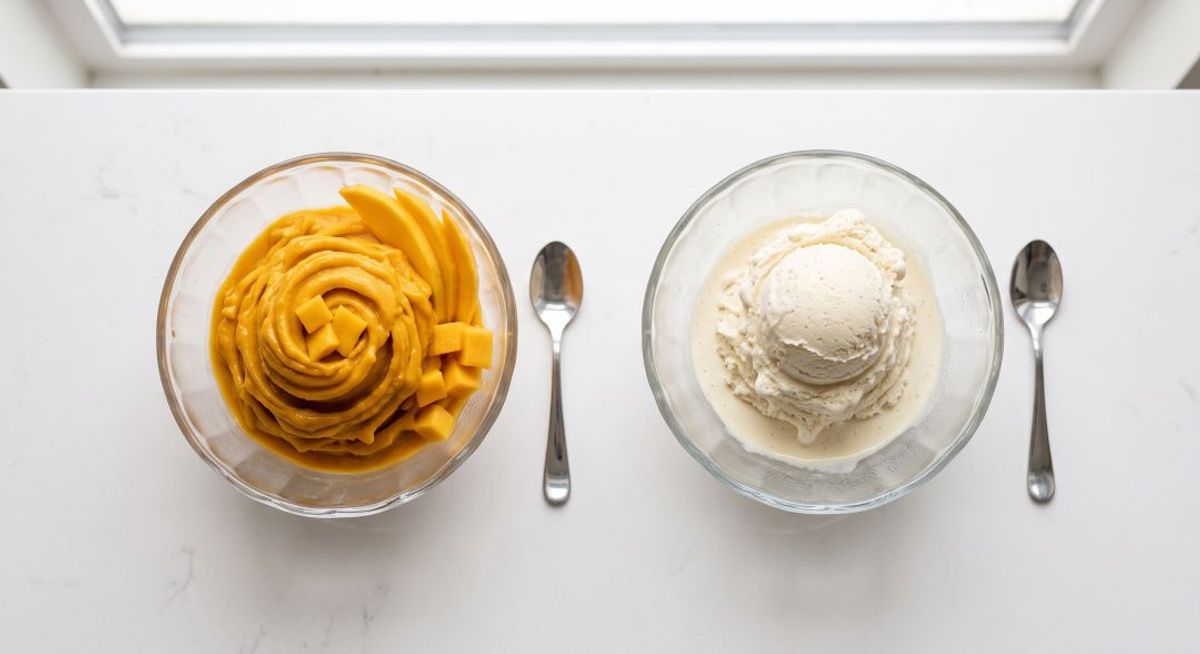
In most American ice cream lineups, the non-dairy option is an afterthought. One sad mango.
In the Italian tradition, sorbet stands on its own. It is fruit and sugar, nothing else, and it lives or dies on the fruit. Blood orange sorbet made with real blood oranges tastes like blood oranges, aggressively, in a way no dairy dessert can match because there is no fat and no milk solids in the way.
Baci's catalog runs 38 sorbet flavors alongside its gelato, which tells you the category is being treated as a peer rather than a box to tick. Same for vegan gelato, which is a separate 15-flavor line rather than a relabeled sorbet.
7. The flavor range is genuinely wider
Because the base is neutral, gelato tolerates flavors that would fight with a heavy cream base.
Look at what is possible: Pistachio, Stracciatella, Hazelnut, Madagascar Vanilla and Salted Caramel on the classic end. Then Black Sesame, Rosemary, Sweet Corn, Halva, Matcha Green Tea, Mastic, Ube, Lemongrass, and Orange Blossom on the experimental end. Fruit sorbets from Lychee to Hibiscus to Passion Fruit.
That is not a novelty list. Those are savory-adjacent, herbal, and floral profiles that only work when the base is not shouting over them.
Baci's wholesale flavor catalog currently runs over 100 flavors across ten categories. Browse it and the pattern is obvious: the classics anchor the list, and the range extends much further than an ice cream lineup typically can.
8. Small-batch production keeps it fresh
Ice cream is engineered for shelf life. It has to survive distribution, storage, and a long sit in a case, which is part of why stabilizers and emulsifiers show up in the ingredient statement.
Gelato is made to be eaten soon. Traditional production runs small batches frequently rather than large batches occasionally.
For a foodservice buyer this is a real operational difference, not a marketing line. Fresher production cycles mean shorter lead times and tighter inventory. Baci's standard lead time is one day for most products. A chef who wants a custom flavor developed is looking at two to four days, not weeks.
9. It performs better on a plate
This is the argument chefs make, and it is the one that never shows up in consumer articles.
A quenelle of gelato holds its shape on a warm plate long enough to be photographed and eaten, but it yields to a spoon immediately. Ice cream at service temperature is either too hard to quenelle cleanly or, once softened, collapses.
Gelato's density also means a smaller portion satisfies. A three-ounce serving of gelato delivers more flavor impact than a larger scoop of ice cream, which matters when you are costing a dessert course.
And a well-made sorbet is one of the few desserts that can close a heavy tasting menu without weighing anything down.
10. Nobody is hiding behind a legal minimum
Here is the reason I find most interesting, and it is the opposite of what you would expect.
Ice cream has a federal standard of identity. Gelato does not.
You might think that favors ice cream. It does not, quite. What the standard actually does is establish a floor: hit 10 percent milkfat, 4.5 pounds per gallon, and the right solids, and you have legally earned the word "ice cream" no matter how the product actually tastes. Miss it and you become a "frozen dairy dessert," which is why that phrase now appears on so many supermarket labels where you would expect the real thing.
Gelato has no floor to hit and no label to hide behind. There is no regulatory box that certifies it. It gets judged entirely on quality ingredients, production method, and whether it tastes like what it claims to be.
That is a harder standard than a legal one. It is also a more honest one.
Gelato vs ice cream vs sorbet vs sherbet: the comparison table
| **Gelato** | **Ice cream (US)** | **Sorbet / sorbetto** | **Sherbet** | |
|---|---|---|---|---|
| **Milkfat** | ~4 to 9% | 10% minimum by law | None | 1 to 2% by law |
| **Base** | Milk-forward, some cream | Cream-forward | Fruit, sugar, water | Fruit with a little dairy |
| **Egg yolks** | Few or none | Common | None | None |
| **Overrun (air)** | ~20 to 35% | Up to 50%+ | Low | Moderate |
| **Churning** | Churned more slowly | Churned quickly | Slow | Moderate |
| **Serving temperature** | Warmer | Colder, ~0°F | Warmer | Cold |
| **Texture** | Dense, elastic, silkier | Fluffy, airy | Bright, clean, icy | Soft |
| **Flavor intensity** | High | Muted by fat and cold | Very high | Moderate |
| **US legal definition** | None | 21 CFR 135.110 | None | 21 CFR 135.140 |
| **Dairy free** | No (vegan versions exist) | No | Yes | No |
What this means if you are buying for a menu
Everything above is food science. Here is the operational translation.
If you run a restaurant, hotel, café, catering company, or gelateria, the case for gelato over ice cream on your dessert menu comes down to three things: it tastes more like what you tell guests it is, it plates better, and it lets you say something specific about your dessert course instead of "we have vanilla."
The buying side has its own considerations, and they are different from the food science. Batch size, delivery cadence, minimum order, flavor rotation, seasonal availability. Our guide to sourcing wholesale gelato and sorbet walks through what to actually ask a supplier, and the seasonal flavor pairing guide covers how to build a rotation that does not go stale in March.
Baci Gelato has supplied wholesale gelato, sorbet, vegan flavors, and accessories (cones, cups, and spoons) to foodservice accounts across New Jersey, New York, Connecticut, and eastern Pennsylvania since 2005. Standard lead time is one day. Custom flavor development runs two to four days. Minimum orders run $150 to $300 depending on location.
If you want the specifics for your operation, see wholesale gelato for restaurants or the New Jersey wholesale program.
Frequently asked questions
Is gelato healthier than ice cream?
Lower in fat, usually. Not necessarily lower in calories. Because gelato is denser, an equal volume can carry comparable calories despite the lower milkfat, and sugar content is often similar or higher. If you want the nutritional breakdown, Healthline's comparison covers it properly. The honest answer is that gelato is a better-tasting dessert, not a health food, and the more useful benefit is that its intense flavor tends to satisfy in a smaller portion.
What is the difference between sorbet and sorbetto?
Nothing. Sorbetto is the Italian word, sorbet is the English one. Same product: fruit, sugar, water, no dairy. Anyone telling you there is a technical distinction is selling something.
Why does gelato melt so fast?
Three reasons stacking together. It is served at a warmer temperature, it has less fat holding structure, and it has less air acting as insulation. Fast melting is a sign the product is right, not wrong. If a "gelato" is sitting there stubbornly holding its shape, it is probably closer to ice cream in formulation.
Is gelato just Italian ice cream?
Yes and no. Literally, gelato means frozen and Italians use it for ice cream generally. Practically, in the American market the word signals a specific production method: milk-forward base, low overrun, churned more slowly, warmer storage temperature and serving temperature. That method is what produces the dense texture and flavor intensity people are actually buying when they choose gelato.
The bottom line
Gelato does not beat ice cream because Italy is fancier. It beats it because of three measurable production choices: less air, less fat, warmer service. Each one increases how much flavor reaches your tongue, and together they compound.
American ice cream optimized for shelf stability, volume, and cost per unit. Gelato optimized for taste. Both are legitimate goals. Only one of them tastes better in the bowl.
The interesting part of the American gelato story is that it took until the 2000s for enough people to taste the difference to care. Once they did, the category stopped being a curiosity. It is worth remembering that the wholesale frozen dessert business in this corner of New Jersey goes back to Marchiony's wagons in 1904. Some things stay good ideas.