
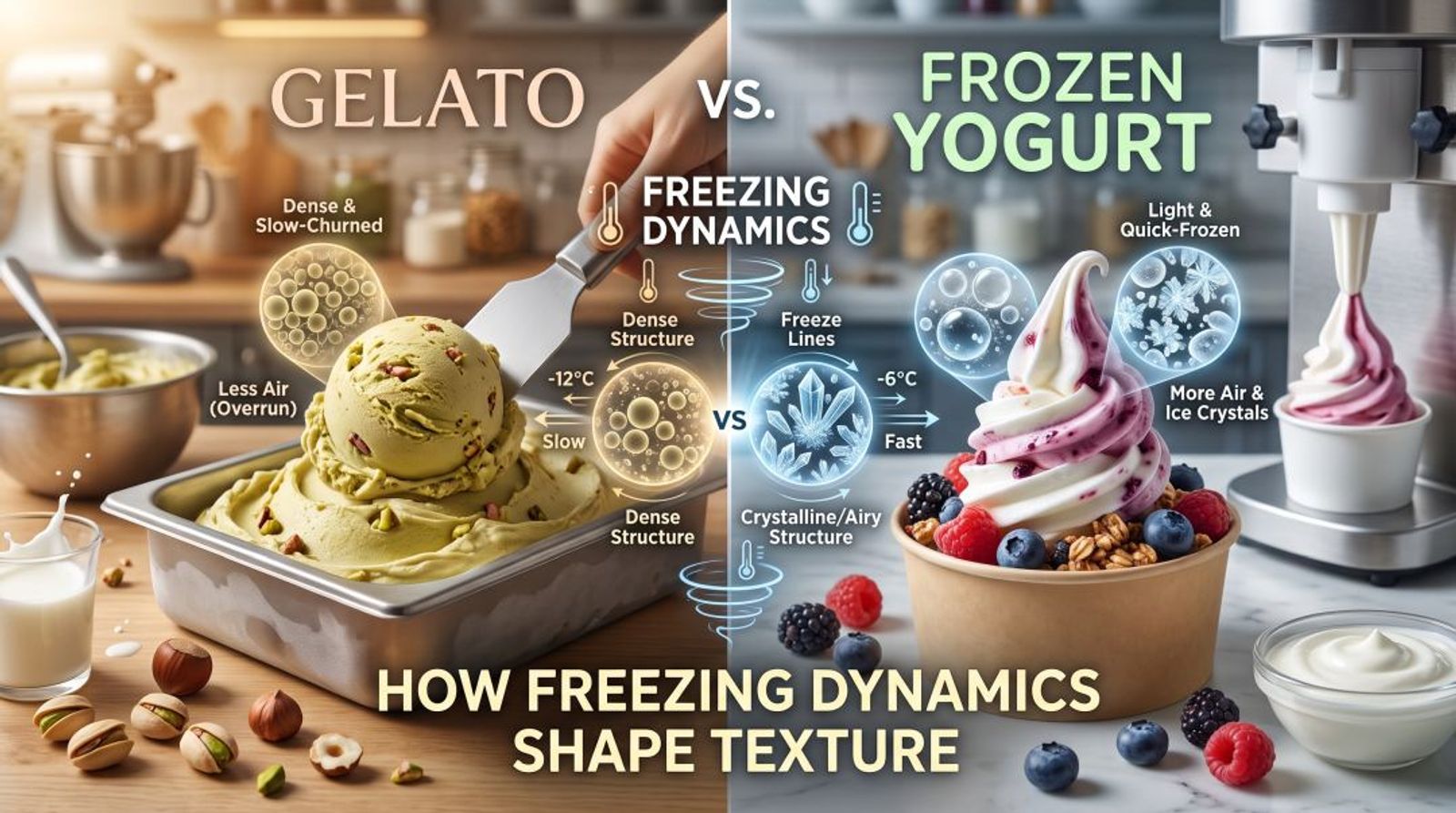
Choosing gelato or frozen yogurt starts with a shared goal: smooth, scoopable texture without coarse ice crystals. When comparing Gelato vs. Frozen Yogurt Freezing Dynamics, the useful questions concern formulation, air, freezing speed, and service conditions.
Both are partly frozen foams: ice and air sit within a concentrated, unfrozen solution of sugars and other ingredients.
The continuous phase is the concentrated, still-fluid matrix surrounding ice crystals, air cells, and other dispersed ingredients. Its sugar, protein, and mineral concentration affects viscosity, freezing point, flavor release, and how quickly the dessert softens.
The dispersed phase includes the ice crystals, air cells, and fat globules distributed through that matrix. Crystal size, air incorporation, and fat-globule interactions determine whether the finished gelato or frozen yogurt feels dense, creamy, airy, or icy.
Why Freezing Dynamics Matter in Gelato and Frozen Yogurt
Churning and freezing determine how much water becomes ice, how crystals grow, and how much air enters the dessert. Holding temperature then determines whether that structure stays smooth or becomes coarse.
For operators, these variables affect consistency between batches and servings. For consumers, they explain why dense, freshly served gelato feels different from tangier frozen yogurt.
The Core Difference Is Not Just Temperature
Sweeteners, proteins, fat, whey solids, cultures, and stabilizers affect the freezing process in different ways. Sugars such as dextrose depress the freezing point, while proteins and stabilizers influence water mobility and structure.
Corn syrup solids contribute body and freezing-point effects that depend on their composition. A lower freezing point alone does not guarantee softness or quality: the entire recipe must balance ice, unfrozen water, and structural support.
A texture analyzer can measure firmness, but tasting at the intended serving temperature remains essential.
At-a-Glance Comparison of Freezing Behavior
Gelato generally contains less fat and air than conventional ice cream, but frozen yogurt is distinguished by yogurt ingredients and acidity, not a fixed density. Recipes and equipment settings vary, so these are tendencies rather than universal rules.
Recommended Table Rows
| Factor | Gelato | Frozen yogurt | What it means on your line || --- | --- | --- | --- || Base | Usually milk-led, fat varies by recipe | Yogurt ingredients, fat varies | Neither name promises richness || Acidity | Usually mild | Distinctly tangy | The tang is the whole point of frozen yogurt || Air content | Typically restrained | Low to high | Less air means a denser bite || Ice crystal size | Fine when frozen quickly | Fine when frozen quickly | Both can go icy || Serving temperature | Warmer than hard ice cream | Depends on format | Compare ready-to-serve portions only || Melting rate | Depends on the recipe | Depends on the recipe | Density alone predicts almost nothing || Common formats | Pans and tubs for scooping | Scooped or soft-serve | Format drives your handling |
Artificial sweeteners do not necessarily replace sugar’s bulk or freezing-point effects. Likewise, a cryoprotectant protects components against freezing damage; the term does not establish superior eating quality.
Gelato Freezing Dynamics: Dense Body and Fine Crystals
Gelato commonly uses batch freezing with restrained aeration. A slow paddle can limit air incorporation, but smoothness also requires rapid heat removal and continuous scraping of the cold freezer wall.
Dissolved sugars lower the freezing point, while milk solids and stabilizers influence body and water mobility. Water removal into ice concentrates the remaining liquid rather than removing water from the dessert.
Overrun and the Role of Air
Overrun is the increase in volume caused by incorporated air during freezing. Lower overrun generally produces a compact bite and can make flavor seem more immediate, although recipe and temperature also matter.
Service Temperature and Scoopability
Gelato is generally served warmer and softer; in ice cream, dissolved sugar keeps roughly a quarter of the water at serving temperature from freezing, according to Scientific Baking’s frozen-desserts reference.
Baci Gelato-style artisan texture is best evaluated through balanced formulation, controlled freezing, and attentive service, not one ingredient claim. The ideal serving temperature depends on the recipe and display case.
Frozen Yogurt Freezing Dynamics: Acidity, Cultures, and Structure
Frozen yogurt uses a fermented yogurt base or yogurt ingredients, giving it characteristic acidity. Nonfat milk solids, proteins, sugars, and stabilizers influence its freezing curve and water distribution.
Sweetener choice matters: high fructose corn syrup and other sugar systems contribute differently according to composition. Frozen yogurt can be dense and scoopable or lighter and aerated.
How Acidity Changes the Eating Experience
Acidity changes perceived sweetness, while fermentation shapes a protein gel matrix that influences body and water binding. An excessively sticky network can be undesirable; ingredients such as inulin can also modify texture.
Research on inulin and glycerol in probiotic frozen yogurt examines formulation effects, rather than establishing one ideal recipe.
Soft-Serve Versus Hard-Scooped Frozen Yogurt
Soft-serve machines freeze and aerate mix during production; hard-scooped formats also need formulations suited to hardening and storage. Live cultures may remain, but freeze injury and storage can reduce viability, so frozen yogurt is not automatically a probiotic product.
The Science Behind Ice Crystals, Air, and Melting
Ice crystallization creates smoothness when crystals remain small. Freeze concentration leaves sugars, milk salts, and other solids increasingly concentrated in the unfrozen phase.
A mantecatore, the Italian term for a batch freezer, combines cooling and agitation. Later temperature fluctuations encourage recrystallization, allowing larger crystals to grow at the expense of smaller ones.
Why Stabilizers and Emulsifiers Are Used
Stabilizers manage water mobility and help limit crystal growth; aging hydration gives these ingredients time to hydrate before freezing. Emulsifiers influence fat interactions and air-cell structure, with results depending on the complete formulation.
Fat globules form part of the dispersed fat structure in dairy-based frozen desserts. Their size, partial coalescence, and interaction with proteins and emulsifiers can support air-cell stability and contribute to a smoother, more cohesive body.
What a Meltdown Test Can Reveal
An analytical balance can track drainage using a gravimetric method, producing a meltdown curve over time. Record shape retention separately: liquid drainage and structural collapse are related but different.
A slow-melting sample is not necessarily creamier or better tasting. Compare equal portions under matching conditions, then assess texture alongside the measurements.
Choosing Gelato or Frozen Yogurt for the Right Experience
Choose gelato for a dense, flavor-forward scoop or cup; choose frozen yogurt for tang and a yogurt-led experience, including customizable soft-serve formats. Neither is automatically healthier: serving size, sugar, fat, and toppings determine the nutritional comparison.
For readers considering Baci Gelato, useful craftsmanship criteria include balanced recipes, small-batch freezing, restrained aeration, and careful display-case service. These qualities are more informative than judging a dessert by its name alone.
Questions to Ask Before Comparing Products
Ask about ingredients, sugar, fat, overrun, serving format, and holding temperature. Taste at the intended service temperature, checking smoothness, stickiness, flavor release, and how the portion softens.
How Does Freezing Affect Gelato Differently from Frozen Yogurt?
Gelato commonly combines low overrun with warmer service than hard ice cream, producing a dense, soft scoop. Frozen yogurt’s acidity and formulation influence its structure, but either dessert can be smooth or icy depending on freezing and storage.
Why Does Gelato Usually Feel Denser and Silkier than Frozen Yogurt?
Restrained air incorporation makes gelato feel compact, while fine ice crystals support silkiness. Frozen yogurt can also be dense and smooth; its texture depends on water, dairy solids, sweeteners, acidity, and processing.
How Do Serving Temperature and Storage Change Their Texture?
Colder temperatures make both desserts firmer and can reduce flavor release. Repeated warming and cooling encourages crystal growth, while controlled tempering before service softens a portion without deliberately cycling the whole batch.
Verdict: Different Freezing Systems, Different Strengths
Gelato typically emphasizes low overrun, dense body, and a warmer, soft-scooping service profile. Frozen yogurt adds yogurt-driven acidity to frozen-dessert processing and spans dense scoops through lighter soft-serve formats.
Neither product has an inherent monopoly on smoothness, creaminess, or melt resistance. Those qualities come from managing water, sugars, air, proteins, freezing rate, and temperature stability together.
For operators, the practical priority is matching the recipe to the freezer, storage conditions, and intended serving format. For consumers, the fairest comparison is between portions served as intended, rather than samples taken directly from cold storage.
Choose gelato when compact texture and direct flavor expression lead the decision; choose frozen yogurt when tang and format flexibility matter more. In either case, controlled freezing and careful service make the difference between a balanced dessert and an icy one.
Gelato vs. Frozen Yogurt: Freezing Dynamics Explained
The key to comparing gelato and frozen yogurt is how each recipe behaves as water freezes—not simply how cold the dessert gets. Sugars help keep some water unfrozen, air affects density, and dairy solids help shape the surrounding structure. Yogurt acidity adds another variable by influencing milk-protein interactions.
These differences create distinct formulation and serving needs, but neither dessert has a fixed texture. Recipe balance, freezing speed, and temperature control determine whether the finished portion feels smooth, firm, airy, or icy.