
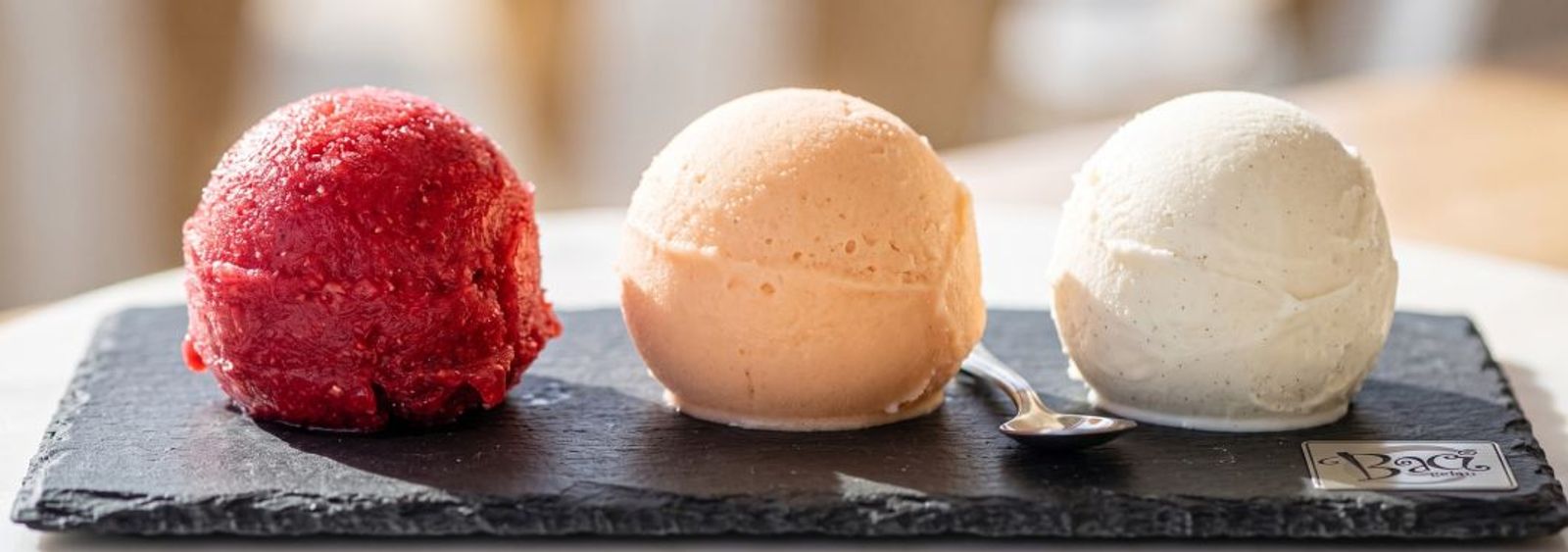
Sorbet vs Sherbet vs Ice Milk: What Actually Separates Them
The short version
- Sorbet is the dairy-free one. Fruit, water, sugar. No milkfat, no exceptions worth arguing about.
- Sherbet has a little dairy in it, and the amount is not a suggestion. Federal rules pin it at 1 to 2 percent milkfat. Under 1, over 2, and it legally stops being sherbet.
- Ice milk is gone. Not the product. The word. The Food and Drug Administration dropped the standard of identity in 1994 and the category got rebranded as low-fat ice cream.
- Sorbetto is sorbet. Same thing, Italian spelling. Nobody is hiding a second product behind the extra letter.
- Texture is a sugar and water problem before it is a dairy problem. That is the part most people get backwards.
Somebody asks the difference between sorbet and sherbet roughly once a week in this business, and the answer usually gets buried under three paragraphs of romance about Emperor Nero and mountain snow. So here it is without the costume drama.
Sorbet has no dairy. Sherbet has a small, legally fixed amount of dairy. Ice milk was a legal term for low-fat ice cream that the FDA retired in 1994 because the name was killing sales. That is the whole answer. Everything below is why it matters when you are the one putting it on a menu or a spec sheet.
Which frozen dessert is dairy-free?
Sorbet. That is the one.
No milkfat, no nonfat milk solids, nothing that came out of a cow. Which means it clears the bar for vegan menus and for anyone who is lactose intolerant without you having to reformulate anything or build a workaround.
That group is bigger than most operators assume. The National Institute of Diabetes and Digestive and Kidney Diseases estimates roughly 30 to 50 million American adults have some degree of lactose malabsorption, and the rate climbs sharply across Asian American, African American, Native American, and Hispanic populations. Look at who actually sits in a dining room in the New York metro area on a Friday night. A dessert list where every single option is dairy is not a neutral choice. It is a decision to lose a table's worth of orders every service.
Sorbet is also just a good dessert. That part gets lost in the dietary framing. It is refreshing in a way a heavy scoop is not, it works as a palate cleanser mid-menu, and it gives a guest who is full a lighter option that is not fruit salad.
Sorbet: fruit, water, sugar, and a lot of arithmetic
Sorbet is fruit puree or fruit juice, water, and sweeteners, churned until it is smooth. Three ingredients on paper. Genuinely difficult in practice.
Here is why. With no dairy in the mix, there is no fat to soften the freeze and no protein to hold structure. All you have is sugar. Sugar is what keeps the water from locking into a solid block, so the sugar load has to land in a narrow window. Producers usually aim somewhere around 25 to 32 degrees Brix, which is just a measure of how much dissolved sugar is sitting in the solution.
Go under that and you get a brick with an icy texture that fights the scoop. Go over it and the thing never firms up properly. There is no fat to hide behind either way, so a sloppy sorbet announces itself immediately.
Good sorbet is not limited to fruit flavors, though that is where most of it lives. Chocolate sorbet is a real and very good thing, built on cocoa instead of milk, and it surprises people who assume dairy-free means fruit-only. Fresh herbs work beautifully, basil and mint especially. Liqueurs show up too, and not just as a chef's flourish. The sherbet regulation explicitly permits distilled alcoholic beverages including liqueurs or wine for flavoring, which tells you how long that practice has been standard.
Sorbetto is the same product. Italian spelling, identical thing.
Italian ice is a close cousin but not the same. It is coarser, more granular, closer to a fruit ice than to a churned sorbet. Different mouthfeel entirely. If you have ever had both back to back on a boardwalk you already know the difference even if you never had a word for it.
Sherbet: the one with a rulebook
Sherbet is fruit plus a small measured amount of dairy, and the measurement is the whole point.
Under 21 CFR 135.140, sherbet has to contain not less than 1 percent and not more than 2 percent milkfat. Nonfat milk-derived solids have to hit at least 1 percent. Total milk solids land between 2 and 5 percent. It has to weigh at least 6 pounds to the gallon. And if the flavor is fruit, it needs a titratable acidity of at least 0.35 percent calculated as lactic acid, which is the regulation's way of saying it has to actually taste bright instead of flat and sweet.
The dairy can come from cream, milk, or buttermilk, among others. Buttermilk sherbet is old-school and underrated. That 1 to 2 percent milkfat does not sound like much, and it is not, but it changes the mouthfeel noticeably. You get a softer, rounder, slightly creamy texture instead of the clean snap of sorbet. Still nowhere near ice cream. It sits in between, which is either the appeal or the problem depending on who you ask.
On the spelling: it is sherbet. Not sherbert. Merriam-Webster has a whole entry on this because the second pronunciation has been so widespread for so long that it has become quasi-legitimate through sheer repetition. Say it however you grew up saying it. Just spell it right on the menu.
Ice milk: a word the FDA killed
Ice milk was the legal name for frozen dairy dessert that came in under the 10 percent milkfat threshold required for ice cream. Lower fat, lower cost, lower everything.
It also sounded terrible. Consumers heard "ice milk" and thought thin, icy, cheap. Sales reflected that.
In 1994 the FDA removed the standard of identity, and manufacturers got to relabel the exact same products as low-fat, reduced-fat, or fat-free ice cream instead. Same formula, better word, and the category recovered. If someone tells you ice milk disappeared, what actually disappeared was the name on the label.
You will still see it referenced in older textbooks and on the occasional regional menu. It is a historical term now, nothing more.
Ice cream: the fat and air standard
Since everything else gets defined against it, here is where ice cream sits.
21 CFR 135.110 says a product cannot be called ice cream in the US unless it carries at least 10 percent milkfat and at least 10 percent nonfat milk solids, and weighs no less than 4.5 pounds per gallon with a minimum of 1.6 pounds of total food solids in that gallon. Premium brands typically run higher on fat content, often in the 14 to 18 percent range.
That weight minimum is the interesting one. It exists to stop manufacturers from whipping so much air into the mix that a half gallon is mostly nothing. The industry term is overrun, and American ice cream commonly runs 50 to 100 percent. At 100 percent overrun, half of what you bought is air.
Air is not the villain here. It insulates, which is why a high-overrun product stays scoopable straight out of 0F storage. But it also dilutes flavor. More air per spoonful means less actual product per spoonful, and your palate notices even if your brain does not.
The International Dairy Foods Association keeps a readable summary of these labeling standards if you want the full picture. 21 CFR Part 135 sits under the Food and Drug Administration, which is part of the Department of Health and Human Services, and it governs this entire category of frozen dessert.
Gelato: less fat, less air, served warmer
Gelato is built on a different set of choices, and every one of them points the same direction.
It leans on milk rather than heavy cream, so fat content typically runs 4 to 9 percent instead of 10 and up. It is churned slowly, so overrun lands around 20 to 35 percent instead of 50 to 100. And it is served warmer, somewhere in the 10 to 20F range, not the 0F an American scoop shop holds.
Three variables, one result. Less fat coating your tongue, less air getting in the way, less cold numbing your taste buds. Flavor arrives faster and hits harder. That is the entire trick, and it is why a pistachio gelato tastes like pistachio in a way a lot of pistachio ice cream does not. Max Falkowitz has written well on why the milk-forward base does this if you want to go deeper.
The warmer service temperature is also why gelato has that dense, elastic, almost stretchy quality. Cold enough to be frozen, warm enough to still yield.
Frozen yogurt and the rest of the shelf
Frozen yogurt is cultured dairy, usually low fat, usually tangy, and usually spun to a soft-serve texture. Different product, different audience, different regulatory footing than ice cream. It gets grouped in with ice cream alternatives but it is dairy, so it does nothing for a vegan or dairy-free guest.
Plant-based frozen desserts built on oat, coconut, or cashew bases have come a long way from the gritty first generation. Coconut and oat dominate because their fat structures behave enough like dairy fat to produce a genuinely creamy texture rather than an approximation of one.
Side by side
| Category | US labeling rules | Milkfat | Overrun (air) | Dairy-free |
|---|---|---|---|---|
| Sorbet / sorbetto | No federal standard of identity | 0% | Low (15% to 30%) | Yes |
| Sherbet | 21 CFR 135.140 | 1% to 2% | Medium (30% to 50%) | No |
| Ice cream | 21 CFR 135.110 | 10% minimum | High (50% to 100%) | No |
| Gelato | No federal standard | 4% to 9% | Low (20% to 35%) | No |
| Frozen yogurt | Cultured dairy, no ice cream standard | Varies, often low | Medium to high | No |
| Ice milk | Standard removed 1994 | Under 10% | High | No |
| Italian ice | No federal standard | 0% | Very low | Usually |
Why texture is really a water problem
Everybody blames fat for texture. Fat matters, but the real variable is what the water is doing.
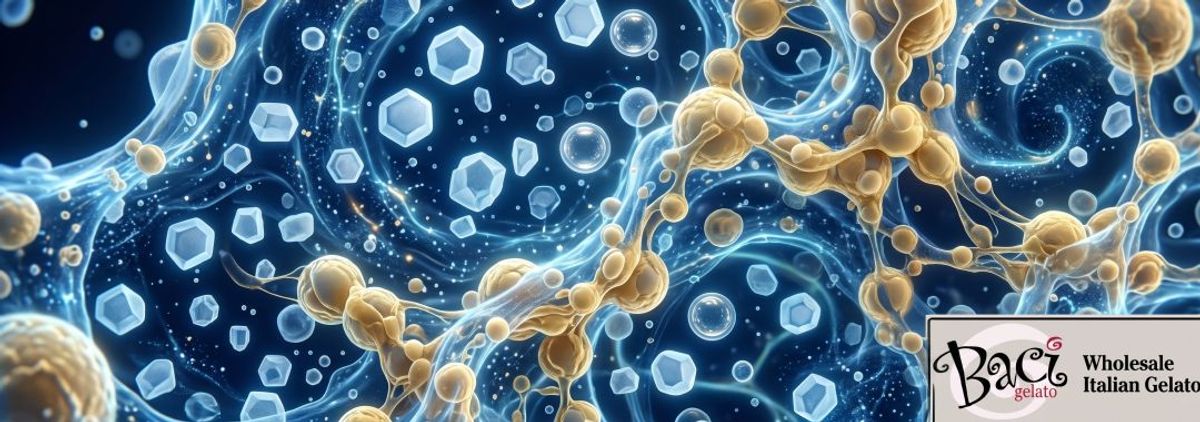
Water freezes at 32F into something you could break a spoon on. To get a frozen dessert you can actually eat, you have to stop the water molecules from organizing into clean crystals. Dissolved solids do that. Sugar, mostly. This is freezing point depression, and it is why sugar in a sorbet is structural, not just sweet.
Different sugars pull different weight. Smaller molecules like dextrose and fructose depress the freezing point close to twice as hard as sucrose does at the same weight. So a producer blending sucrose, dextrose, and glucose is not chasing a sweetness level. They are engineering exactly how soft the product sits at service temperature. Sweetness is the side effect they then have to correct for.
The other half is crystal size. Smoothness is basically a crystal measurement. Ice crystals under about 50 micrometers read as smooth on the tongue. Past that your tongue starts picking them out individually, and you get that coarse, sandy defect nobody can unnotice once they have noticed it. The churn process is what keeps crystals small, by agitating the mix continuously while it freezes so nothing gets a chance to grow. A commercial batch freezer is running the same physics as a countertop ice cream maker, just with far more control over how fast the heat leaves.
And here is the part that undoes good work quietly: temperature swings. Research using scanning electron microscopy on frozen desserts held across a range of storage temperatures found that product kept colder and steadier resisted recrystallization far better, while product held warmer showed visibly larger ice pores and scored worse with trained tasting panels. Every time a product softens and refreezes, crystals fuse into bigger crystals. That damage does not reverse. A perfect sorbet that sat on a loading dock for twenty minutes is no longer a perfect sorbet, and no amount of refreezing fixes it.
Which is a long way of saying that how a product gets to you matters as much as how it was made.
What this means on a real menu
A few things I would push on if you are building a dessert program.
Carry at least one dairy-free option and mean it. Not as charity. As arithmetic. Between vegan guests, lactose intolerant guests, and people with a sweet tooth who still do not want a heavy scoop after a heavy entree, a good sorbet is one of the highest-converting items on a dessert list.
Use sorbet where it does work, not just where it ends the meal. A small scoop between courses resets a palate. On a tasting menu it earns its place structurally, not as an afterthought.
Watch your service window. Low-overrun products like gelato and sorbet hold their shape well on a warm plate, which buys the pass more time than a high-overrun scoop does. That is an operational advantage, not a tasting note.
Margins are the quiet argument. Ready-to-serve gelato and sorbet skip the labor a plated pastry demands. No prep, no skilled hands, no waste from a tray that did not sell. Dessert is one of the few places on a menu where you can hold high margin without asking the kitchen for anything extra.
Where Baci Gelato fits
We make gelato and sorbet in Norwood, New Jersey, and we have been doing it since 2005. Over twenty years in, wholesale only, which means restaurants, hotels, caterers, cafes, gelaterias, and specialty retailers. Not homes, not individuals, not shipped in a box with dry ice.
We deliver ourselves across New Jersey, New York, Connecticut, and eastern Pennsylvania on our own refrigerated trucks. A hotel in Manhattan, a caterer in Fairfield County, a restaurant group working the Philadelphia corridor, a cafe in South Jersey. Same trucks, same cold chain, no third-party handoff where things sit on a dock and quietly lose their texture.
The flavor catalog runs past 100, with dairy-free sorbets making up a large share of it. Madagascar Vanilla and Stracciatella on the gelato side. Yuzu, Blackberry Cabernet, and a proper chocolate sorbet on the dairy-free side. Vegan options sit in there too, not as a token SKU but as a real section of the list.
Lead time is one day on stock items. If a chef wants something built from scratch, custom flavor development runs two to four days. That is it. No four-week development cycle, no batch minimums on a custom run.
Minimum order sits between $150 and $300 depending on where you are. Accessories like cones, cups, and spoons come off the same order, so you are not chasing a second supplier for the small stuff.
If you are working out what to stock, the tri-state sourcing guide covers formats and ordering in more depth, and the seasonal pairing guide is the one to read if you are building a rotating list. More on the restaurant wholesale program and the New Jersey program, or you can just talk to us.
FAQ
What is the actual difference between sorbet and sherbet? Dairy. Sorbet has none, so it is dairy-free and works for vegan menus. Sherbet contains 1 to 2 percent milkfat, which federal rules require, and that small amount gives it a softer, slightly creamy texture. Sherbet is still much lighter than ice cream.
Is it sherbet or sherbert? Sherbet is the correct spelling and the one on every federal document. Sherbert is a very common variant pronunciation that has been around long enough that dictionaries now acknowledge it. Spell it sherbet in writing.
Is sorbetto different from sorbet? No. Sorbetto is just the Italian word. Same product, same method, nothing hidden behind the spelling.
Is ice milk still sold in the United States? Not under that name. The FDA removed the standard of identity for ice milk in 1994, and those products are now labeled low-fat, reduced-fat, or fat-free ice cream. The products exist. The term does not.
Is sorbet always vegan? Traditional sorbet is fruit, water, and sugar, so yes. But some producers use stabilizers or additions that are not plant-based, and Italian ice and sherbet get confused with sorbet constantly. If it matters for your menu, confirm with your supplier rather than assuming.
Why does gelato taste stronger than ice cream when it has less fat? Because of the less fat, not despite it. Fat coats your palate and slows flavor release. Gelato runs 4 to 9 percent milkfat, carries far less air, and gets served warmer, so flavor compounds reach your taste buds faster and your taste buds are not numbed by cold. Three small choices stacking into one big difference.
The takeaway
Sorbet, sherbet, and ice milk are not three grades of the same thing. They are three different answers to the same question about how much dairy belongs in a frozen dessert, and two of those answers are written into 21 CFR Part 135 in exact percentages.
Knowing which is which is table stakes. What actually shows up in the bowl is craft: the sugar balance, the churn, and whether the cold chain held from the production floor to your pass. Get those three right and a scoop of fruit, water, and sugar can be the best thing on the menu.