
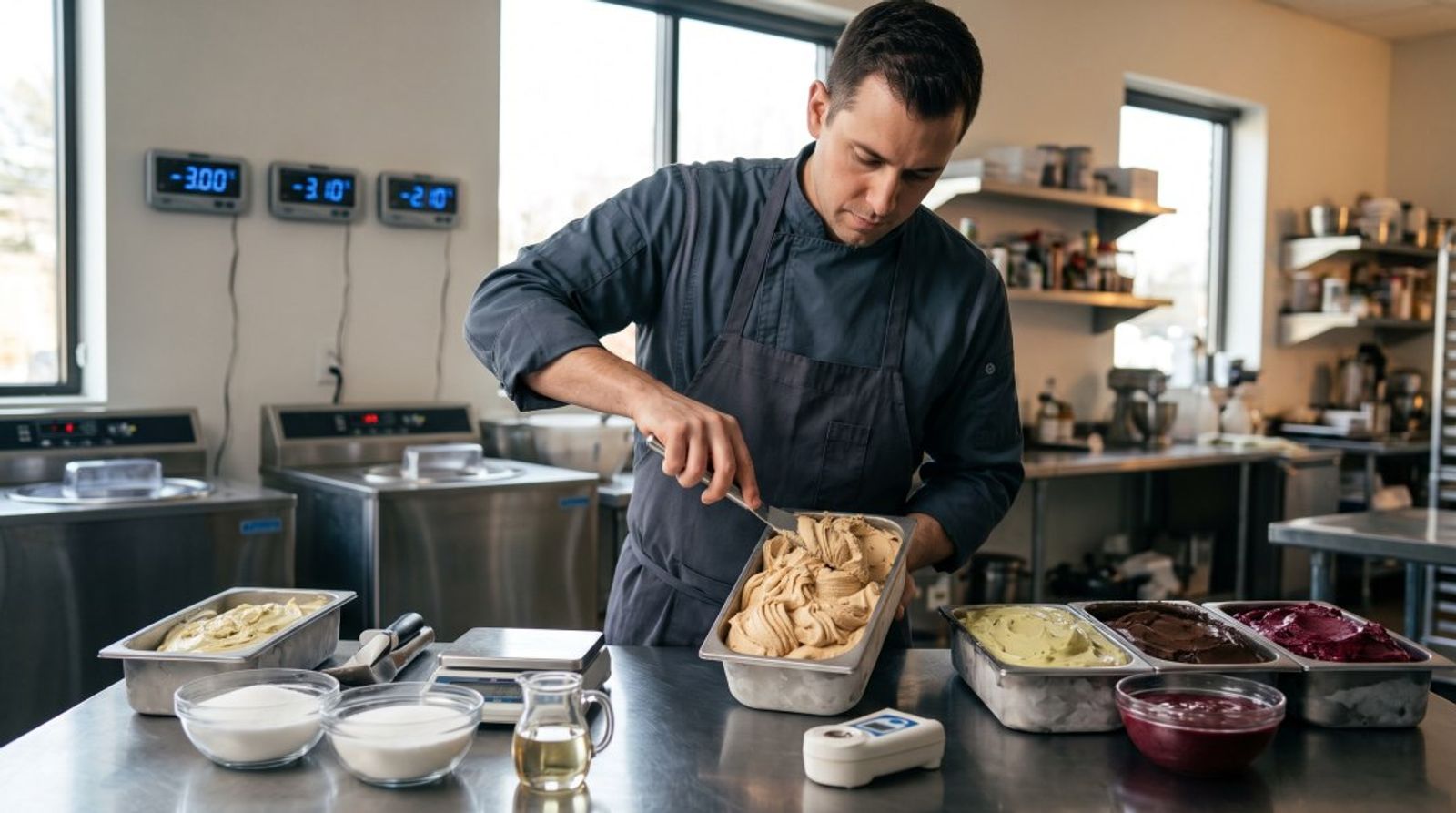
Ask five gelato makers how they handle sugar and you will get five answers. Ask them how the product portions at the temperature you actually hold it at, and the answers get shorter fast.
That is the real question underneath all of it. Freezing point depression decides how much of the water in a pan has turned to ice and how much is still liquid at serving temperature. Sucrose, dextrose, glucose syrup, invert sugar, maltodextrin, each one shifts that balance differently because the effect is colligative. It tracks the number of dissolved molecules, not how sweet the stuff tastes. Table sugar and lactose are disaccharides. Dextrose and fructose are monosaccharides with a lower molecular weight, so gram for gram they drop the freezing temperature further while contributing less sweetness. That gap is the whole reason alternative sugars exist in frozen dessert formulation, and it is why sugar reduction projects almost never come down to swapping one ingredient for another.
This page covers both halves of the decision: who to buy from in New Jersey, and what the science actually means when you are standing at the pass with a scoop in your hand.
5 Authentic Italian Gelato Makers in New Jersey, Ranked for Wholesale Buyers
A ranking of five New Jersey makers, judged on what a wholesale buyer can verify: who they actually sell to, how fast they move product, and how much of a straight answer you get when you ask about texture at your service temperature.
1. Baci Gelato, Norwood
The one to call first, and not by a small margin.
Baci has been producing authentic Italian gelato and sorbet in Norwood since 2005, which puts the company past the 20 year mark. Ingredients come in from Italy. The flavor library runs past 100 profiles, and the company develops custom flavors with a chef in 2 to 4 days. Standard lead time on everything else is one day. More than 400 wholesale partners across New Jersey, New York, Connecticut, and eastern Pennsylvania get deliveries on Baci's own refrigerated trucks, which matters more than most buyers realize. Every handoff to a third party fleet is another chance for temperature abuse, and temperature abuse is what turns a well balanced pan into an icy one. Recrystallization does not care how good the formula was on the day it was made.
Why it ranks first on a page about freezing point depression: Baci is a manufacturer that makes to order rather than a brand that sits on inventory, so what you taste in a sample is what shows up on the truck. Short production to service windows limit the thermal history that drives ice crystal growth. That is a formulation advantage you get for free, before anyone talks about PAC values, sugar composition, or cost per pan.
What to ask them: describe your service, your portion style, and the temperature you hold product at. Then ask what scoops cleanly under those conditions. You will get a product recommendation instead of a lecture.
2. Nasto's Old World Desserts, Newark
Newark's Ironbound, since 1939, now into a fourth generation of the Nasto family. Frank Nasto III has described the operation as the largest ice cream manufacturer in New Jersey, running roughly 3,000 gallons a week, with around 750 New Jersey restaurants on the books. Most of the business is wholesale.
The catch for anyone shopping specifically for gelato: Nasto's is a broad old world dessert house first. Tartufo, spumoni, bisque tortoni, cassata, cakes, sorbet. Gelato lives inside that catalog rather than defining it. If your menu wants a deep gelato and sorbetto bench with rotating flavor work, this is not the shortest path. If you want Italian American classics with real Newark provenance and a supplier that has survived eight decades of the frozen dessert business, it is a serious name.
What to ask them: which items are produced on a gelato base and which are built as ice cream, since overrun and fat levels differ enough to change portioning and meltdown on the plate.
3. Gelotti, Paterson
Salvatore Sigona opened Gelotti on Union Avenue in 1984 after trips to Italy convinced him the texture there was worth chasing. Four decades on it is still family run, still on Union Avenue, and still one of the few North Jersey names that locals will drive out of their way for.
Gelotti sells wholesale alongside the scoop shop, and the catalog spreads across gelato, ice cream, frozen yogurt, and Italian ice. That breadth is a strength for a café that wants one delivery covering several categories. It is a weakness if you want a supplier whose entire production discipline points at gelato. Different products, different solids, different ice fractions, different behavior in the same storage.
What to ask them: lead times and route days for wholesale accounts outside the immediate Paterson area, and whether flavor availability shifts with the retail season.
4. Guerriero Gelato, Montclair, Caldwell, and Pine Brook
Mike Guerriero learned the trade inside the Gelotti operation, then went out on his own with his wife Breanna and rebranded the shops he had been running. He has taken first place in international competition, including a win for a blueberry basil gelato, and the product is made in house and hand packed rather than bought in.
This is the most craft forward name on the list. Small runs, inventive flavor work, a maker whose personal reputation is attached to every pan. The trade off is scale. A multi site hotel group or a catering operation ordering in volume with tight replenishment windows is a different ask than a restaurant wanting 20 pans of something nobody else in town has.
What to ask them: production capacity per week and how far they deliver, before you build a menu around a flavor.
5. Gelato Envy, Rockaway
Mike Rocca's shop sits on Route 46 in Morris County, and the sourcing story is specific in a way that is easy to verify on the plate: milk, fruit, and herbs from nearby farms, Valrhona chocolate from France, vanilla from Madagascar, hazelnuts and pistachios from Italy. Nothing artificial, which Rocca says often and the flavor backs up. It is made daily on the premises rather than delivered in.
For wholesale, this is the smallest operation here and the most regional. Northern Morris County and the immediate ring around it is the realistic service footprint. Inside that radius you get genuine artisan product and a maker who will talk through a custom flavor. Outside it, the logistics stop making sense.
What to ask them: minimum order, delivery radius, and whether a flavor you fall in love with can be produced consistently month after month.
Four Things to Settle Before You Order
Picking the maker is the easy part. The agreement is where wholesale relationships go wrong.
Lead with how you serve, not with a flavor name. A scooped dessert, a plated component, and a catered service make different demands on the same pan. A product balanced for clean scooping at your holding temperature may read too soft when it is quenelled onto a warm plate, and a firmer one that holds shape beautifully on the plate may fight your staff during a rush. Say which problem you are solving and the conversation gets useful immediately. If you have a flavor list, separate the must-haves from the nice-to-haves, so the discussion can stay on what is actually available.
Judge the gelato inside the dish. Perceived sweetness is contextual. Next to a sweet sauce, a crisp pastry, an acidic fruit, or a warm component, the same product reads differently. Formulators separate these targets on purpose, using POD for relative sweetness and PAC for freezing point depression power, because softness and sweetness are not the same dial. When you tell a supplier you want something less sweet, be clear whether you mean the taste or the texture. Those are two different requests and they get two different products. And if several flavors will share one service routine, talk about them together, because different recipes do not behave identically under one rule.
Nail the commercial terms before the menu print date. Minimums, pricing, flavor availability, order cutoffs, route days, payment expectations, how changes get communicated. Keep these separate from your formulation questions. A product can be perfect and still fail you if replenishment does not match your volume. Share a realistic demand estimate, say whether it comes from an established menu or a new concept, and flag the events and seasonal peaks that will spike it.
Plan the cold chain on your side. Formulation cannot rescue poor handling. Ice crystal size grows during temperature cycling, and repeated warming and refreezing drives recrystallization that no sugar blend prevents. A pan held steady at -18°C behaves nothing like one that drifts twice a week. Work out who receives the delivery, where it goes, who checks storage temperature, and what happens when a reading drifts. Then ask the supplier for product specific handling guidance instead of assuming your existing routine transfers.
Why Alternative Sugars Change Gelato Texture
Freezing point depression is the drop in the temperature at which water starts to freeze once something is dissolved in it. For a buyer, the practical version is simpler: it sets the ratio of ice to liquid in the pan at the temperature you serve at, and that ratio is most of what you feel in the scoop.
Gelato never freezes into one solid block. Water turns to ice in stages, and every bit that freezes leaves the sugars and other soluble ingredients more concentrated in what remains. That remaining liquid is the serum phase, and the process is called freeze concentration. It is why the freezing curve bends instead of running straight, and why two pans sitting side by side at the same temperature can feel like different products. Their recipes simply leave different amounts of ice and unfrozen water behind.
The Number of Dissolved Molecules Matters
Freezing point depression is a colligative property. It depends on solute concentration, not on what the solute tastes like. Any non-volatile solute counts. Smaller molecules give you more of them per gram, so they do more work.
Dextrose, which is glucose, is a monosaccharide, a single unit sugar. Sucrose, the table sugar everyone starts with, is a disaccharide built from two linked units. Their molecular weights differ, so equal weights do not contribute equally. Their sweetness differs too, and that mismatch is the lever: you can move texture without moving perceived sweetness by the same amount.
Underneath, this is Raoult's law and the cryoscopic constant of water doing the work, usually expressed through molality, molar concentration, or mole fraction, and measured against the freezing point of water as zero. Hydrogen bonds, hydroxyl groups, molecular mass, and the molecular structure of each sugar all feed the same outcome. Water activity gets watched alongside it, because the water content of the mix sets the ceiling on ice content and the unfrozen water left at service temperature sets how the product behaves in the hand.
The tidy version breaks down at real concentrations, which is worth knowing before anyone waves a number at you. Once the unfrozen serum phase gets crowded, non-ideal interactions take over and solute-water interactions stop behaving. Hydration shells overlap, excluded volume effects and solute clustering kick in, and activity coefficients drift away from one. Chemical potential, degree of dissociation for anything ionic, and the molar contribution of each component all stop lining up with the simple model. This is why the calculated freezing point and the measured one diverge at the concentration range that matters, and why every serious formulator checks the prediction against a real freezing curve.
None of that gives you a universal swap ratio. Water, total solids, every other dissolved ingredient, and the processing conditions all move the result. A phase diagram or a freezing point estimation method gets a formulator close. Nothing gets them all the way without making the product.
Softness and Sweetness Are Separate Targets
Formulators run two numbers side by side. POD is shorthand for relative or perceived sweetness. PAC is shorthand for freezing point depression power. They describe different contributions from the same ingredient, and keeping them separate is the entire point of using a blend instead of leaning on sucrose alone.
A blend buys independence. Change the blend, though, and you have changed the recipe, not one isolated property. Bulk moves, total solids move, sweetener solids move, and the body of the finished product moves with them.
For a buyer, this means "less sweet" is a sensory description, not a specification. It says nothing about sugar content and it is not a nutrition claim. If your menu depends on specific wording, settle that language with the supplier before anything goes to print.
What the Science Means at the Counter
A balanced product portions more easily and reads smoother at its intended serving temperature. But the balance is not sugar alone. Ice crystal size, fat, milk solids, protein, stabilizers, incorporated air, and the way the mix was frozen all land in the same result.
Freezing point depression on its own does not prevent coarse ice crystals and does not guarantee scoopability. A sugar balance that is exactly right can still produce a disappointing pan if the product sat through poor storage or warmed and refroze on the way to you.
So use the science to be specific, not to chase an extreme. Describe the firmness, the sweetness, the smoothness, the portion definition, and the eating experience you want. An ice-free taste on day one means nothing if the pan goes sandy in week three, so talk about shelf life through your routine, not just the first scoop. Asking for maximum softening effect is asking for a product that will not hold its shape. Gelato formulations and ice cream formulations diverge here, since the lower overrun and lower fat in gelato leave less margin for a sugar balance that is off.
The Sugar Options, One at a Time
What follows is context for the conversation, not a disclosure of what is in any particular Baci Gelato product.
The useful question is never which sugar is best. It is how a whole formulation balances sweetness, solids, water, flavor, cost, and frozen texture for the job it has to do.
Sucrose as the Reference Point
Sucrose is the benchmark because it does four jobs at once: sweetness, bulk, dissolved solids, and freezing point depression. Everything else gets measured against it, often in sucrose equivalents, so blends can be compared on one scale.
The limitation is that the four jobs are welded together. Add sucrose to soften a product and you have also added sweetness and total solids. You cannot move one without moving the others.
That is not a mark against it. It just means you should judge the finished product rather than reading the length of a sweetener list as a quality signal. A short list is not purer and a long list is not more engineered. For menu planning, the question is whether the sweetness supports the whole plate. A balance that is perfect for a standalone scoop can read cloying next to a sweet beverage, a sauce, or a baked component.
Dextrose and Glucose Syrup
Dextrose delivers more freezing point depression per gram than sucrose and less sweetness. That is exactly why formulators reach for it when they want a softer product without a sweeter one.
It still has to be balanced across the recipe. More dextrose is not automatically better, especially if the result goes too soft for your service conditions and starts showing poor shape retention on the plate.
Glucose syrup is a category, not a synonym for a fixed amount of dextrose. How it behaves depends on its mix of glucose and longer carbohydrate chains, plus its own water and solids. Dextrose equivalent, or DE, describes how far the starch has been broken down, and degree of polymerization, often reported as a mean degree of polymerization, describes the chain lengths left behind. Useful technical information, but DE alone will not predict sweetness, viscosity, or how the frozen product performs.
Corn syrups, corn syrup solids, hydrogenated corn syrup, HFCS, maltose, maltose syrup, maltotriose, and maltodextrin with longer oligosaccharides all add sweetener solids without much sweetness or much freezing point depression. Palatinose, resistant dextrins, and soluble corn fiber turn up when someone is chasing a lower load of glycemic carbohydrates. Palm sugars and rarer monosaccharides such as xylose appear occasionally, usually for flavor rather than physics. Lactose from the milk solids is already in the system whether anyone counts it or not, and solubility limits decide how much of anything can actually dissolve before crystallization risk shows up.
Worth checking which form of dextrose is in play, too. Dextrose monohydrate carries about nine percent water; anhydrous dextrose does not. Same ingredient on the label, different contribution to the water and solids balance.
One more thing that catches people out: liquid syrups bring water with them, dry ingredients do not. Any substitution changes the water to solids balance, so it needs a formula wide look rather than a swap by weight.
Invert Sugar and Fructose Systems
Invert sugar is sucrose split into glucose and fructose. That change in composition moves sweetness, water interactions, and freezing behavior all at once.
Fructose containing systems affect flavor perception as well as firmness, and how much depends on the dose and on everything else in the recipe.
Here is the part worth remembering. A change made to improve softness can also make a product sticky, slow to harden, prone to a waxy melt, or less stable in storage. These things travel together. Chasing a softer scoop as the single development goal is how you end up with a product that scoops beautifully and collapses on the plate.
For a wholesale buyer the priority stays the finished experience: does it portion cleanly, does it suit the dish, does it hold through the service routine you actually run.
Sugar Alcohols and Other Low-Digestible Sweeteners
Sugar replacement conversations and sugar-reduced frozen dessert formulations usually start here. Polyols, also called sugar alcohols, include erythritol, xylitol, sorbitol, mannitol, maltitol, isomalt, and lactitol. Allulose, tagatose, and trehalose are sugars rather than polyols but come up in the same conversations. Polydextrose and inulin act mainly as bulking agents and soluble fibers, carrying bulk and total solids without the added sugars or the calories.
None of these are interchangeable. Solubility, crystallization tendency, relative sweetness, sensory effect, and digestive tolerance all vary by ingredient and by how much you use. Tagatose crystallization risk is a real formulation constraint, not a theoretical one. Several low digestible sweeteners carry a laxation threshold and a laxation effect at higher use levels, which is a limit on how far a formulation can go, not a footnote.
High-intensity sweeteners, also called high-potency, non-nutritive sweeteners, are a separate tool. Steviol glycosides, Stevia glycosides, Reb M, monk fruit sold as monkfruit concentrates, sucralose, aspartame, acesulfame K, and thaumatin replace sweetness and contribute no bulk and no freezing point depression at all. Matching the original on sweetness equivalence still leaves you short on solids, and the sweetness time-intensity curve rarely lands in the same place.
Which is the real lesson of this whole category: reducing sugar means replacing functions, not just sweetness. Bulk, dissolved solids, and freezing behavior all still have to come from somewhere. Plant-based frozen desserts add their own wrinkle, since coconut fat and the hydrogenation history of whatever replaced the dairy change how fat crystallization behaves.
If your concept depends on a particular sweetener system or a label claim, get qualified formulation, regulatory, and labeling review. Do not read suitability into the phrase "alternative sugars" or into an ingredient's reputation.
Balance Scoopability with Shape, Body, and Stability
The target was never the lowest possible freezing point. It is a product with the body and the serving behavior you need under the storage and service conditions you actually have.
Too much unfrozen material and shape retention suffers. Too much ice and it fights the scoop. Where the useful balance sits depends on the recipe and on how the product gets handled after it leaves the plant.
And because freeze concentration keeps changing the system as it freezes, ingredient adjustments do not scale neatly. A small change can produce a disproportionate result, which is why development runs on iteration rather than arithmetic.
Use Calculations to Guide Evaluation
PAC gives technical teams a workable way to compare freezing point depression contributions across ingredients. The freezing point depression factor, or FPDF, is the same idea under a different name. Tools like the Ice Cream Calculator, Excel spreadsheets built out with Solver, Weast's equation, and a simple extrapolation method between known points let food technologists estimate ice fraction at a target temperature before anyone makes a batch. You will also see PACtot quoted for a whole formulation, and normalized PAC used to compare recipes with different water contents on an even footing.
What the numbers cannot do is describe eating. They will not confirm flavor release, sensory creaminess, sensory taste, resistance to melting, melting rate, shelf life, consumer acceptability, or ease of portioning. For that you need the product.
In a development lab that means measured freezing curves and ice curves, differential scanning calorimetry for heat flow, onset temperature, melting enthalpy and the enthalpy of fusion, a rheometer for premix viscosity and serum viscosity across a range of shear rates, and a texture analyzer running compression force through a forward extrusion rig to put a number on hardness at serving temperature. Meltdown gets its own rig: a sample on a metal mesh, dripped phase mass weighed against melting time to give a meltdown rate. Thermocouples and a climatic chamber or temperature control chamber handle temperature cycling and thermal history work, with the rate of temperature increase set deliberately rather than left to the room. Statistical treatment follows, usually a linear regression analysis with a coefficient of determination reported alongside standard deviation across replicates, all of it resting on an experimental design somebody thought about first. HPLC analysis, nuclear magnetic resonance, spectrophotometry, and infrared spectroscopy sit behind the ingredient characterization.
You do not need any of that. Wholesale buyers need a clear description of the performance they expect and a realistic way to test against it. Can a portion be formed consistently? Does it hold through the actual preparation sequence? Write down the conditions when you check, including the holding temperature and how long the pan sat out, because an observation without conditions is just an opinion, and it will not help the next conversation with your supplier.
Protect Texture Through Temperature Control
Cooling rate, draw temperature, and hardening conditions decide the initial ice crystal network. Everything that happens afterwards can only make it coarser. Later temperature swings drive recrystallization, where large crystals grow at the expense of small ones, and iciness arrives.
This is the part formulation cannot cover for. Repeated warming and refreezing changes texture even when the ingredient mix was right on production day. Heat transfer, convection, and the thermal conductivity of a full pan mean the core temperature lags the air around it, with a real lag time and a temperature gradient from edge to center, so a brief door opening is forgiving and a sustained drift is not. Instability shows up later, as lost smoothness rather than as anything you can see on delivery day.
Agree receiving, storage, and serving practice with the supplier directly. Ask for guidance specific to the product, and keep short term preparation for service separate from long term storage. On your side, cut out unnecessary movement between temperature conditions and give one person responsibility for checking storage and reacting when a reading drifts outside range.
Consider the Full Gelato System
Water supplies everything that can become ice. Dissolved ingredients decide how much of it stays liquid at a given temperature. But body comes from more than that.
Fat and the fat network it builds, milk protein, skim milk powder, whey solids, egg yolks, cacao powder, cocoa powder, and total solids all contribute, and they shift the Brix of the mix as they go. Overrun and air cell stabilization decide how much of the pan is product and how much is air, which changes both the eating experience and the economics.
Stabilizers and hydrocolloids such as guar, locust bean gum, tara, cellulose gums, and carrageenan influence premix viscosity, serum phase viscosity, water mobility, and water binding capacity, which slows ice crystal formation and growth. They are not freezing point depressants and nobody should sell them to you as substitutes for one. Resistance to flow at a given shear rate is a different measurement from hardness, and the two do not always move together.
Salt as NaCl, ethanol, glycerol, and propylene glycol all depress freezing point too, which is why an alcohol based flavor behaves differently from its base. Anti-freeze agents is the loose shorthand some suppliers use for the whole group. Dynamic freezing in a continuous machine, fractional freezing, and liquid nitrogen methods each leave a different ice crystal network behind, even from identical mixes.
Total solids matter because taking sugar out changes more than sweetness. A replacement strategy that restores sweetness without addressing bulk and water balance gives you a different dessert, not a lighter version of the same one.
Packaging and service practice add one more layer. The same product reads differently straight out of storage than it does under your serving conditions. So assess the system before you blame an ingredient. A precise description of when and how a texture problem shows up is worth more than a theory about the sugar blend.
How to Brief a Supplier
A good brief covers three things: your menu, your purchasing reality, and your cold chain. Here is the order that works.
Your application. Business type and the role gelato plays. Individual scoops, plated desserts, catered service, or something else. Service pace and presentation expectations, since a dessert assembled to order has different workflow demands than one plated for a coordinated event service. If sweetness is the concern, describe the surrounding dish. "Balanced beside a sweet pastry" tells a supplier far more than "less sugar."
What you need back. Which flavors, formats, and wholesale options fit the application. How the product is meant to be stored and served. Written handling guidance where it exists, so your team can build one routine and repeat it. If your menu depends on a particular nutrition profile or specific ingredient language, settle the wording before publication rather than after, since product names and general descriptions will not support a specific claim on their own.
The commercial side. Ordering procedure, minimums, current pricing, payment expectations, fulfillment, and how timing lines up with your launch date. Confirm how availability gets communicated and how repeat orders get placed, then keep those details somewhere the purchasing and receiving staff can actually find them. Establish all of it directly with Baci Gelato rather than carrying assumptions over from a previous supplier.
The evaluation. Ask whether samples or a product discussion are available. If so, agree which products and applications get looked at first. Taste the product alone, then taste it inside the intended dish, and note flavor balance, portioning behavior, presentation, and how much effort it takes during a real service. Record the handling conditions and the sequence you used instead of logging an overall preference. Then summarize what you have agreed, products, terms, and operating requirements, and close the open points before treating a first conversation as a confirmed arrangement.
Frequently Asked Questions
How does freezing point depression affect gelato made with alternative sugars?
Dissolved sugars lower the freezing temperature and change how much water is still unfrozen at serving temperature, which is most of what you feel when you scoop. Replacing sucrose by weight will shift firmness, but the outcome also depends on total solids, processing, and the rest of the recipe. There is no clean one for one swap.
Why use dextrose instead of relying on sucrose alone?
Dextrose contributes more freezing point depression per gram and less sweetness than sucrose, so a blend lets a formulator move texture and sweetness independently. The catch is that adding dextrose without rebalancing the rest of the recipe produces a product that is simply too soft.
What is the difference between PAC and POD?
PAC measures freezing point depression power, which is how much an ingredient softens the product. POD measures relative sweetness. Two ingredients can share a POD and have very different PAC values, which is exactly why formulators track both.
Does a softer gelato mean less sugar?
No. Softness tracks the number of dissolved molecules, not sweetness, so a product can be softer and sweeter, or firmer and less sweet. "Less sweet" describes taste. It is not a statement about sugar content and it is not a nutrition claim.
How can a wholesale supplier apply alternative-sugar science?
By weighing sweetener choices against solids, water, and processing to hit the serving texture your operation needs. Ask Baci Gelato which products suit your menu and your service conditions rather than assuming a particular sweetener system is the answer.
Why does the same gelato scoop differently in two kitchens?
Usually thermal history, not formulation. Temperature cycling during delivery and storage drives recrystallization, and larger ice crystals make a pan feel harder and coarser. Steady holding temperature does more for texture than any sugar blend can.
Start Your Wholesale Conversation with Baci Gelato
Contact Baci Gelato with your business type, intended menu application, preferred flavors or formats, estimated demand, storage setup, and desired launch timing. Ask about current wholesale options and the next step for your inquiry.