
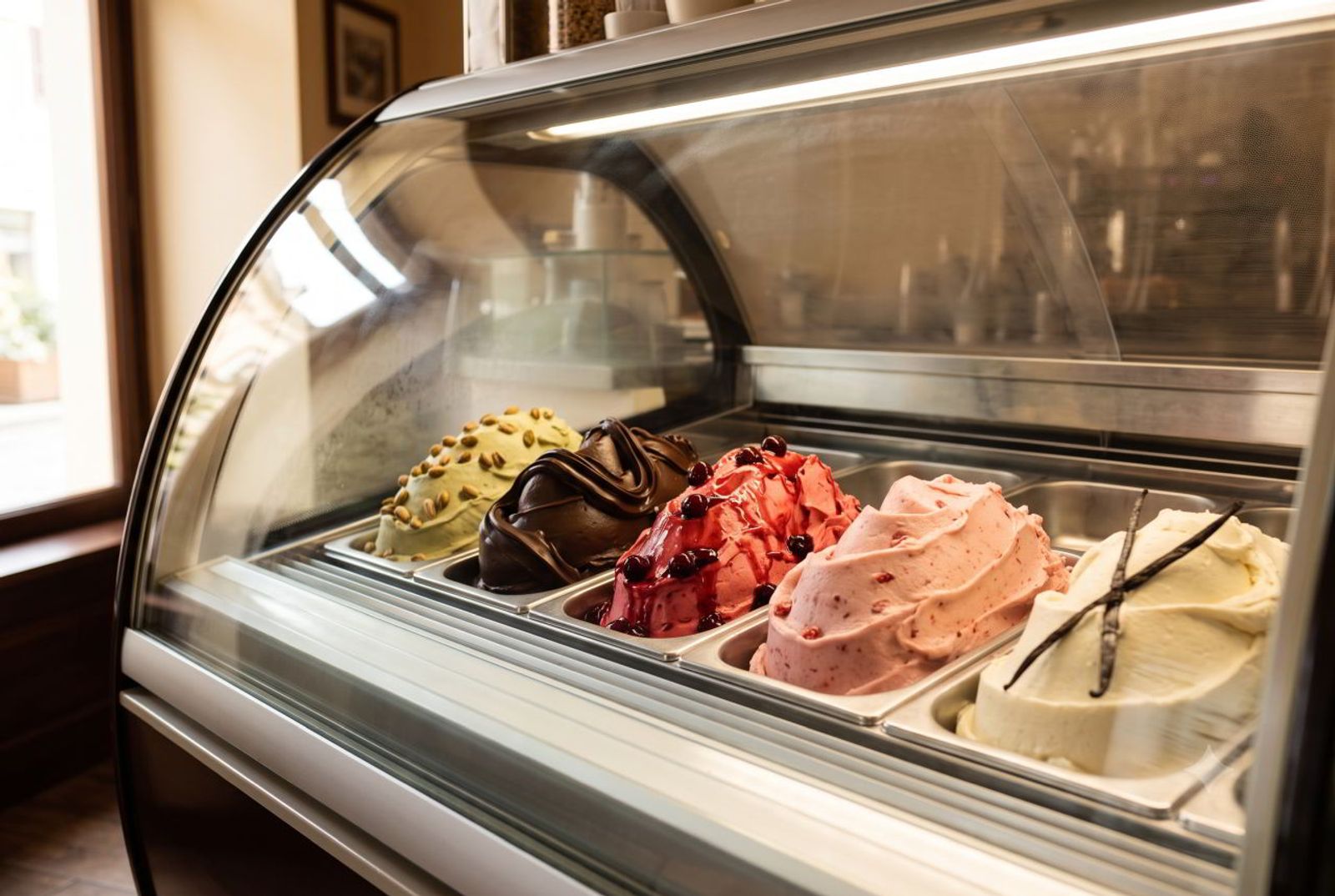
Short answer: an authentic Italian gelato wholesale supplier makes gelato and sorbetto using Italian techniques and premium ingredients, sells B2B to restaurants, cafés, hotels, caterers, gelaterias, and gourmet markets, and delivers cold. In the United States that describes a small group. Villa Dolce Gelato and G.S. Gelato at national scale, Gelato-Go Wholesale in Miami, il laboratorio del gelato and L'Arte del Gelato in New York City, Gelotti and Baci Gelato in New Jersey, and a scattering of regional producers everywhere else.
The word "authentic" does almost no legal work in this category, which is exactly why it gets used so much. So this guide covers where the tradition actually comes from, who is really making the product in America, and the handful of operational questions that decide whether a supplier will work for your café.
Key Takeaways
- There is no federal standard of identity for gelato, so "authentic Italian" is a claim about method and ingredients, not a regulated category. Ask what the method is.
- The oldest Italian frozen dessert wholesale operation in the New York metro ran out of Hoboken, New Jersey, starting in 1904. The regional model is not new.
- Most national gelato brands sell you their catalog. A smaller producer can build a customized flavor that only your café serves.
- Lead time and container sizes matter more than flavor count once you are actually running a case.
- Baci Gelato develops branded flavors with your chef in 2 to 4 days, produced in Norwood, New Jersey, and delivered on its own refrigerated fleet across New Jersey, New York, Connecticut, and eastern Pennsylvania.
How Italian Gelato Got to America
Worth knowing, because the history explains why the good suppliers still look the way they do.
Florence, the 1560s
The most cited origin story puts a Florentine architect named Bernardo Buontalenti at the Medici court, asked to build something spectacular for a visiting Spanish king. What he made was a frozen dessert with milk, eggs, and sugar. Not a fruit ice. Something creamier, closer to what we now call gelato.
The claim is contested and probably too tidy. Sicily had been freezing fruit and sugar into sorbetto for centuries before that, a technique with Arab roots that came with the island's Arab rule. What is not contested is that dairy entered the picture in Renaissance Italy and changed the product permanently. The Carpigiani Gelato Museum keeps the more careful version of this history if you want to go deeper.
Paris, 1686
Francesco Procopio dei Coltelli, a Sicilian, opened Café Procope in Paris and sold frozen desserts to the public rather than to a court. First commercial gelateria, more or less. He also worked on the freezing method itself, which is the part that mattered, because consistency is what turns a novelty into a trade.
New York, the 1890s
Here is the part most gelato histories skip, and it is the most relevant one for anybody reading this in America.
Italian immigrants brought the trade with them. Italo Marchiony arrived in New York in the mid 1890s and sold lemon ices and frozen desserts from a pushcart on Wall Street, in small glass cups that customers kept breaking or pocketing. So he baked waffles, folded them warm into cups, and in December 1903 patented the mold that made them. The International Dairy Foods Association has the fuller account of how that turned into the cone.
The following year he did the thing that actually matters here. He set up a wholesale frozen dessert business in Hoboken, New Jersey, and ran a fleet of horse drawn wagons out to retailers across the metropolitan area.
A New Jersey production facility, its own delivery fleet, supplying accounts across the New York metro. That was 1904. The trucks are refrigerated now and the paperwork is worse, but the model has not changed, and there is a reason it keeps working in this region.
1980s to now
Gelato went from an Italian American neighborhood product to a national category over roughly three decades. Chains arrived, then the artisan pushback against the chains, then the wholesale manufacturers who could supply both. The International Dairy Foods Association tracks how these frozen dessert categories get defined and consumed in North America, and gelato sits awkwardly inside that framework to this day. Which is roughly where the current landscape comes from.
Gelato, Sorbetto, and What Your Café Is Actually Buying
Quick and useful, because menu descriptions get written badly.
Gelato is churned slower with less air and served warmer than American ice cream. Less overrun, denser body, and because it hits your tongue warmer, the flavor reads louder. It also carries less butterfat, which is counterintuitive to most people who assume dense means rich.
Sorbetto and sorbet are the same thing. Fruit, sugar, water, no dairy. The Italian word is not a different product. Anyone who tells you otherwise is selling something.
Plant-based and non-dairy gelato is its own formulation problem, not gelato with the milk removed. Pull the dairy fat out and you lose what was carrying the body, so sugar and solids have to do that work instead. A vegan pistachio that eats like the dairy version is a genuinely hard build, and if you want the science rather than the sales pitch, Penn State's food science program is a good non commercial place to start.
One regulatory note. The FDA sets standards of identity for ice cream and related frozen desserts under 21 CFR Part 135, and gelato does not have one. There is no legal test for "authentic Italian gelato" in the United States. It is a claim about ingredients, technique, and who is making it, and the burden is on you to check.
The Authentic Italian Gelato Wholesale Landscape in the United States
Roughly four kinds of supplier, and they solve different problems.
| Supplier type | Examples | Best for | Trade-off |
|---|---|---|---|
| National wholesale manufacturers | Villa Dolce Gelato (Glendale, AZ), G.S. Gelato (Fort Walton Beach, FL) | Multi-state groups, grocery, private label programs | You buy their catalog and their scale |
| Private label and co-packing specialists | Gelato-Go Wholesale (Miami, FL) | Brands launching their own labeled product | Volume commitments, longer runways |
| Regional producers | Baci Gelato (Norwood, NJ), Gelotti (NJ), il laboratorio del gelato and L'Arte del Gelato (NYC) | Cafés and restaurants inside the delivery footprint | Geography is the hard limit |
| Ingredient houses | MEC3 (Rimini, Italy) | Gelaterias producing in house | You still have to make the product |
Villa Dolce Gelato, founded 2001 and now operating out of Glendale, Arizona, is the largest national wholesale gelato brand by distribution, moving artisan gelato and sorbetto through a couple hundred distributors and packing formats up to 5 L per unit. G.S. Gelato, in Fort Walton Beach, Florida since 1996, runs a similar model with a heavy private label business for grocery. Both are good at what they do. Neither is going to develop a flavor for one café in Hartford.
Gelato-Go Wholesale in Miami sits squarely in private label and co-packing. If your goal is your own branded pints on a shelf, that is the lane.
Regional producers are the ones most café owners should actually be calling, and the reason is boring and practical: someone answers the phone, the product arrives on their own truck, and the batch was made this week. In the northeast that means operators like Gelotti and Baci Gelato in New Jersey, or il laboratorio del gelato and L'Arte del Gelato in New York City. In California and the west the equivalents are different names, same structure. Black Market Gelato in Boise, Idaho is a good example of the retail end of this, a gelateria rather than a wholesale supplier, which is a distinction worth checking before you call anyone.
MEC3, out of Rimini, has made ingredients and semi-finished products for artisan gelato since 1984 and exports to well over a hundred countries. Relevant only if you are producing in house. If you are a café, you want finished product, not bases.
Custom and Branded Flavors: Where Baci Gelato Fits
This is the part of the category most cafés do not know is available to them.
Baci Gelato is a wholesale Italian gelato and sorbet manufacturer in Norwood, New Jersey, founded in 2005. Twenty plus years, family operated, supplying more than 400 restaurants, hotels, caterers, gelaterias, specialty retailers, and gourmet markets across New Jersey, New York, Connecticut, and eastern Pennsylvania.
They make gelato, sorbet, vegan gelato, and gelato accessories. Cones, cups, spoons. No ice cream. They will tell you that themselves, and it is a useful signal about how a producer thinks about its own category.
What a branded flavor actually gets you
Most wholesale suppliers sell you their catalog. Baci does that too, and the flavor catalog is deep: over 100 flavors across classic flavors and seasonal collections, including Madagascar Vanilla, Chocolate, Pistachio, Hazelnut, Salted Caramel, Tiramisu, Amarena Cherry, and a 38 flavor sorbet range that covers everything from Blood Orange to Lemon Basil. The vegan line runs 15 flavors, including plant-based Vanilla, Chocolate, Strawberry, Pistachio, and Hazelnut.
But the catalog is the floor, not the ceiling. Baci also develops custom flavor solutions with your chef, meaning tailor-made recipes that exist only on your menu.
That matters more for a café than it sounds. Every café within a mile of you can buy the same national pistachio. None of them can buy your pistachio with your olive oil and your sea salt on it, under your name. Custom branding on a flavor is the cheapest menu differentiation available in this category, and almost nobody uses it.
How custom flavor development works here
- Lead time is 2 to 4 days for a custom flavor developed with your chef. Most catalog products ship in 1 day once your account is set up. That is not a typo, and it is the single biggest structural advantage a regional producer has over a national manufacturer.
- Limited-edition offerings and seasonal collections work the same way, which makes a rotating monthly flavor a realistic program rather than a fantasy.
- No private label, no co-packing. Baci states plainly that it does not white label or co-pack other manufacturers' products. Everything comes out of Norwood. If you wanted your own labeled retail pints, this is the wrong supplier and you should be calling Gelato-Go or G.S. Gelato instead. If you wanted to know exactly where your product was made, that constraint is the whole point.
- Ingredients are imported from Italy and the production follows Italian techniques, which is the substance behind the authentic Italian craftsmanship line rather than the marketing version of it.
There is more on how flavors get built around a menu rather than a catalog in their seasonal flavor pairing guide.
What a Café Should Check Before Choosing a Supplier
Six things. In this order, because this is the order they will bite you.
1. Container sizes. Match the format to the service, not the price. Small-batch gelato in a 2.5 quart pan suits a plated dessert program. A 6 liter decorated pan is built for a display case where customers see the product. A 5 L per unit format suits volume service and catering. Getting this wrong means either constant reordering or product sitting too long.
2. Minimum order. Ask how it is calculated. Some suppliers quote in dollars, some in units per format. Baci's minimums run per format, starting at four pans on the 5 liter and 6 liter decorated, eight on the 2.5 quart, two units on the 2.5 gallon. Low enough that a single café can open an account, which is not true everywhere.
3. Lead time. For catalog product, 1 day is achievable from a regional producer. National manufacturers running through distributors will not match that. Ask specifically about reorder lead time, not just first order lead time, because vendors quote whichever number flatters them.
4. Cold-chain delivery. Ask who owns the trucks. A supplier running its own refrigerated fleet controls the whole chain. A supplier handing off to a third party courier does not, and in August that difference shows up in your case as a texture problem you will get blamed for. Baci runs its own refrigerated routes multiple times a week, which is the kind of foodservice reliability that only becomes visible when it fails somewhere else.
5. Wholesale pricing. Most serious B2B gelato suppliers do not publish a public price list, and that is normal rather than evasive. Pricing is volume tiered and account specific. What you should insist on is a written quote against your actual formats and volumes before you commit. If you want to sanity check where dairy input costs are heading before you lock a number, the USDA Economic Research Service publishes the underlying data.
6. Free samples. Any supplier confident in the product will send a sample box at no charge and no commitment. If they will not, that tells you something. Taste it cold, taste it after twenty minutes in a case, and taste the vanilla, because vanilla is where a mediocre producer has nowhere to hide.
On food safety standards, ask about facility certification and process control directly and get the answer in writing. A vague response is itself an answer.
For a regional breakdown of who covers what, their tri-state supplier overview is a reasonable starting point, and cafés running events alongside counter service should look at the catering program rather than the standard wholesale terms.
Frequently Asked Questions
What makes a gelato supplier "authentically Italian"? Method and ingredients, since there is no legal definition. Look for Italian technique, lower overrun, premium ingredients imported from Italy where the flavor depends on origin, and small-batch production rather than continuous industrial runs. Then verify by tasting, because every supplier in the category claims all of it.
Can a café get its own custom gelato flavor? Yes, from a producer that develops rather than just distributes. Baci Gelato builds customized flavors with your chef on a 2 to 4 day lead time, which means a branded flavor or a limited-edition seasonal offering is a normal request, not a special project. National manufacturers generally cannot do this at single-café volume.
What container sizes do wholesale gelato suppliers offer? Common foodservice formats run from roughly 2.5 quart pans up through 5 liter, 6 liter decorated pans for display cases, and 2.5 gallon bulk units. Match the size to how fast you turn a flavor. A gorgeous flavor moving too slowly in an oversized pan is a worse outcome than a boring one that sells.
Do Italian gelato wholesale suppliers deliver nationally? Some do, through distributor networks. Regional producers do not, and that is deliberate. A producer running its own refrigerated fleet trades national reach for control of the cold chain and short lead times. Baci Gelato, for example, delivers across New Jersey, New York, Connecticut, and eastern Pennsylvania only. Outside that footprint you want a regional producer local to you or a national manufacturer.
Bottom Line
The authentic Italian gelato wholesale category in the United States splits cleanly. National manufacturers give you scale, distribution, and private label. Regional producers give you speed, cold-chain control, and the ability to put something on your menu that nobody else has.
For a café, the second list is usually worth more. Foot traffic does not care that your supplier ships to 40 states. It cares that the pistachio is good and that it is yours.
If you are in New Jersey, New York, Connecticut, or eastern Pennsylvania, Baci Gelato is worth a sample box: over 100 flavors, a vegan and sorbet range deep enough to build a case around, custom flavors in 2 to 4 days, biodegradable packaging options, and their own trucks. Samples are free and carry no commitment, which makes the first step cheap.
Outside that region, apply the same six questions to whoever is local to you. The questions travel better than the recommendations do.